Event · 24/02/2024 · Ankara, Türkiye
Game Production and Publishing at CS Tech 360
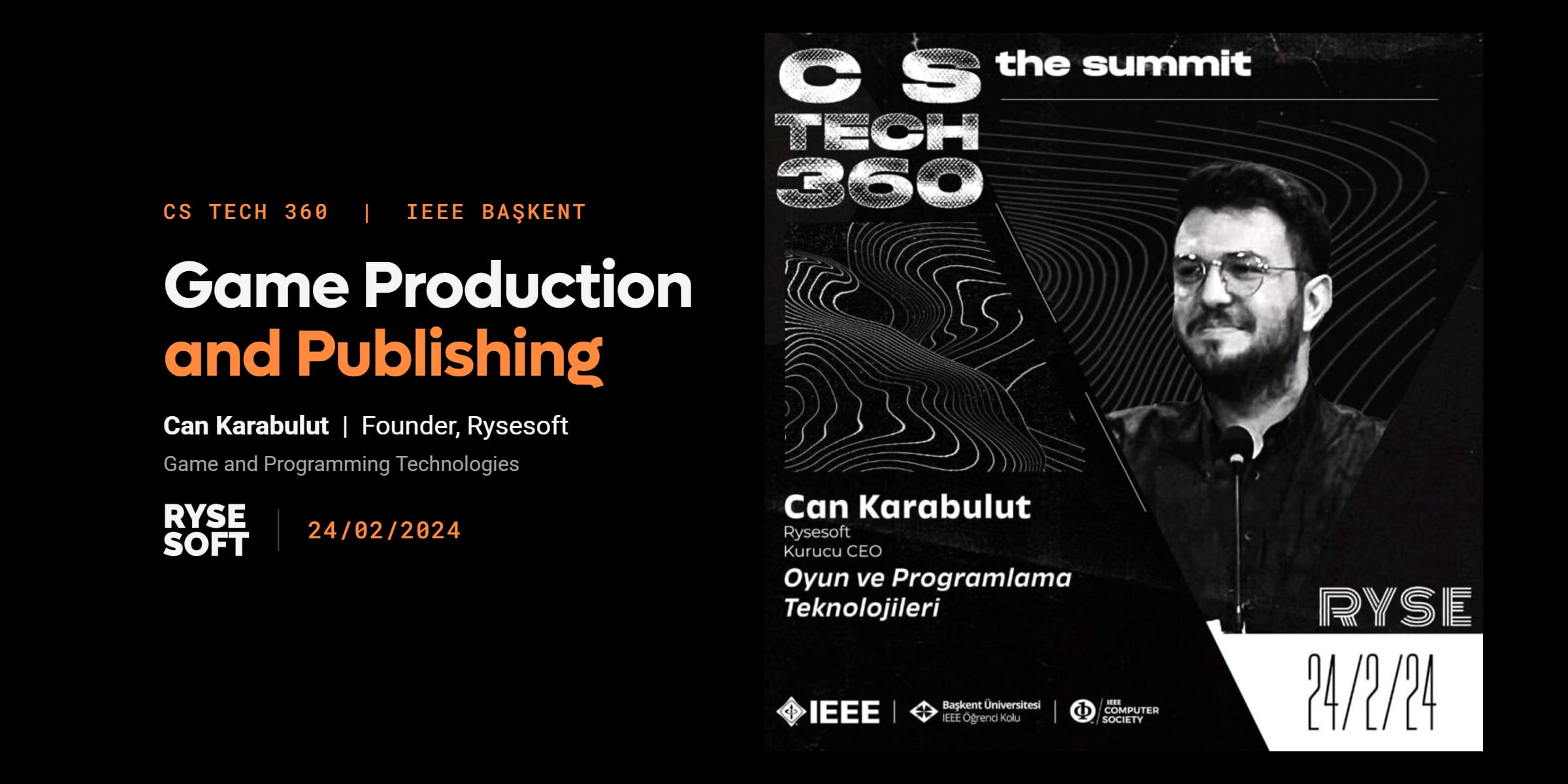
The IEEE Başkent University Student Branch and its Computer Society opened the 2023 to 2024 spring term with their summit CS Tech 360. Our founder Can Karabulut, a computer engineer, took part as a guest in the Game and Programming Technologies session. He spoke about how a digital game is made and how it reaches its players.
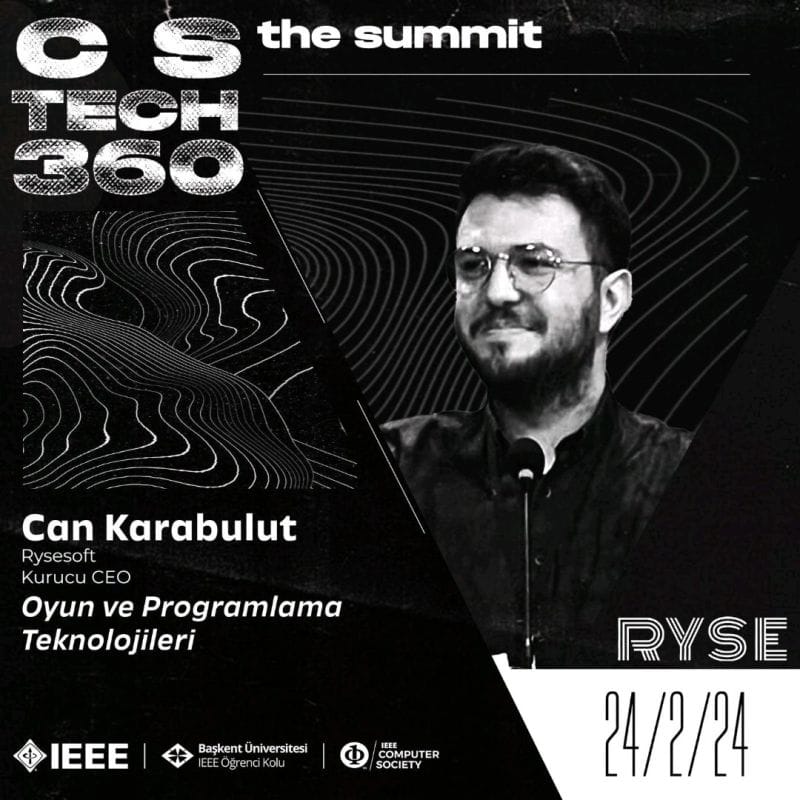
Below we share the topics of the talk, in the order of the slides.
A short history of games
The first interactive digital game is usually said to be Spacewar, developed by Steve Russell at the Massachusetts Institute of Technology in 1962 and played by two people. We followed the road from that early experiment and the oscilloscope screens of the time to the colourful simulations of the late 1990s such as RollerCoaster Tycoon.
Game or simulation
A game is made to entertain. It relies on mechanics such as scores and levels, and its story and art carry much of the experience. A simulation models the real world for training or analysis. It tries to follow real physical rules as closely as possible and gives the user live data and feedback. Military training systems, where soldiers practise with simulated equipment and virtual battlefields, were our examples of how far simulations reach.
Game engines
Large studios often build their own engines, such as Decima, Northlight, RAGE and the engine of Naughty Dog. Most teams start with Unreal Engine, Unity or Godot. Unity is a C# based engine for games, films, animation and simulations, and Google develops SDKs especially for Unity. For anyone who wants to go deeper, we recommended Game Engine Architecture by Jason Gregory, lead programmer at Naughty Dog.
Game production is an engineering discipline
A game starts with a Game Design Document (GDD). It holds the summary of the game, the gameplay, the mechanics, the game elements and the assets, and grows with the story chapters, the 2D, 3D and sound assets, the level design and the timeline. A plan pays off. Project statistics from 2020 show a success rate of 92 percent when the plan is followed, while only 29 percent of all projects are fully successful and 19 percent fail completely.
The technical side is written in a Technical Design Document (TDD or SDD). We talked about the patterns in Game Programming Patterns by Robert Nystrom, such as Command, Flyweight, Observer, Prototype, Singleton and State, and about Game Loop, Event Queue and Dirty Flag. The document also covers the database design with ER diagrams and the choice between SQL and NoSQL, the services and APIs a dynamic game needs, microservices for busy systems with several databases, UML use case and sequence diagrams, CRC cards and the classes and functions of the game.
The market and its risks
Using the sales of 60 Seconds on Steam, Epic Games and Xbox as an example, we looked at how a game grows over the years. A SWOT analysis then showed the usual weak points. A beta that lasts too long, slow decisions, a plan that is too loose, too many bugs and too little marketing all hurt a game. The idea that a game takes off once two YouTubers play it is a myth, and spending on ads without a budget opens a hole. A game can also age, its technology can fall behind, updates can become impossible and third party software can cost too much. Still, the market is huge. The global digital games market was worth 281.77 billion dollars in 2023 and is expected to reach 655.77 billion dollars by 2030.
AI in games
We gave an overview of the AI techniques used in games. State machines and finite state machines, pathfinding, behaviour trees, rule based systems, neural networks, Monte Carlo tree search and utility systems were on the list. The A* algorithm finds the lowest cost path between two points. Flocking imitates the movement of bird and fish swarms. Genetic algorithms can study a player's style and tune the difficulty to their skill. We covered these topics in depth in our game AI training at Başkent University.
Publishing your game
Publishers are companies that publish and market a game and take a commission on its sales. The giants of the sector are Steam, the Epic Games Store, Google Play and the App Store. Epic Games, for example, takes 12 percent of a sale.
Company, taxes and incentives
To sell a game you need a company, which in Türkiye can be a sole proprietorship, a limited company or a joint stock company. Sales abroad count as a service export, and taxes and forms such as W-8BEN-E come with them. There is also support for game studios. KOSGEB, TÜBİTAK, the Ministry of Trade with up to 300,000 dollars, the exemptions of technology development zones and TEKMER centres, social security and corporate tax incentives, private funds and angel investors can all help a studio grow.
Thank you
Many thanks to the IEEE Başkent University Student Branch and its Computer Society for inviting us. If you want to work with us, you can apply for an internship on our career page, and you can find our programmes on the training and certification page.
Photos
On social media
- Date
- 24/02/2024
- Time
- 13:00
- Location
- Başkent University, Ankara, Türkiye
 Date
 Time
 Location